Describe How Light Changes With Depth in the Ocean
Transitional waves are often wind-generated waves that have moved into shallower water. The aphotic zone exists in depths below 1000 meters 3280 feet.

Ocean Depth Underwater Wildlife Infographic Vector Illustration Educational Oceanography Diagram Stock Vector Illustration Of Dragonfish Fishing 172026898
Freezing during the process increases its salinity.

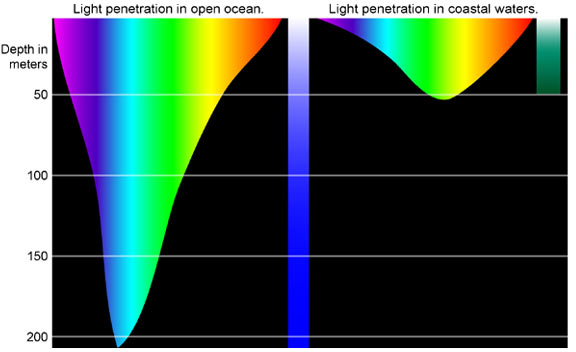
. The oceans exude power and confindence yet its are the connector to everyone. In the ocean solar energy is reflected in the upper surface or rapidly absorbed with depth meaning that the deeper into the ocean you descend the less sunlight there is. Blue light penetrates best green light is second yellow light is third followed by orange light and red light.
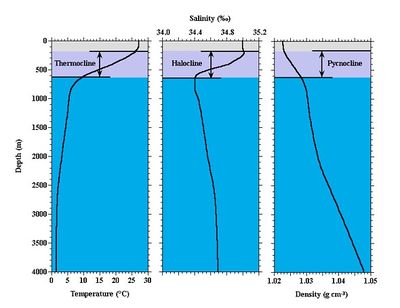
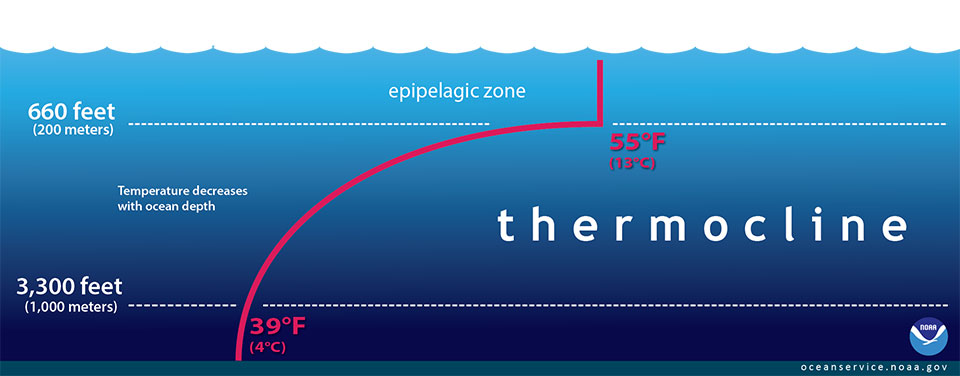
Upwelling is the movement of cold water upward from the deep ocean. Therefore the deep ocean below about 200 meters depth is cold with an average temperature of only 4C 39F. Light lessens temperature drops and the water becomes more dense due to increased salinity.
Deep-water waves include all wind-generated waves moving across the open ocean. You can feel an increase of pressure on your eardrums. Water pressure is greatest at the bottom of the ocean and this is one of the reasons that humans cannot tolerate diving in deep water.
At the surface of the ocean the euphotic zone the ecosystem receives plenty of light and oxygen is fairly warm and supports many photosynthetic organisms. In this zone the intensity of light rapidly dissipates as depth increases. The ocean has a complex circulation system called the Global Ocean Conveyor.
Eg below 10m depth red or long wave lengths missing therefore red colours are no longer visible. Open ocean ecosystems vary widely as the depth of the ocean changes. The bright white calcium carbonate spheres excel at reflecting light producing the milky turquoise-blue color of a coccolithophorid bloom.
Red light is quickly filtered from water as depth increases and red light effectively never reaches the deep ocean meaning animals that live in deep water and are red are essentially invisible. In clear water in the tropics the noon compensation depth may be well below 100 m throughout the year. Only about 25 percent of incident light reaches a depth of 10 meters in the open ocean where water is very clear.
Water clarity is a measure of how far down light penetrates through the water column. At very great depth salinity increases again because the water near the ocean bottom originates from polar regions where it sinks during the winter. The only light at this depth and lower comes from the bioluminescence of the animals themselves.
Acoustic Properties Light and sound are two principal carriers of information used in human and animal communication. Define upwelling and explain its importance. The depths from 1000-4000 meters 3300 - 13100 feet comprise the bathypelagic zone.
Greater abundances of solid particles in. At greater depth ocean life also become more narrow of body. 20 brainliest for whoever answers correctly and answers all choose the statements that accurately describe chinas one child policy chinas one child policy began as soon as the communists came to power.
This results in less warming of the water. Due to its constant darkness this zone is also called the midnight zone. Sunlight does not penetrate to these depths and the zone is bathed in darkness.
This is due to an increase in hydrostatic pressure the force per unit area exerted by a liquid on an object. If the surface mixed layer is too deep by the time the phytoplankton cells are deep enough to reach the nutrients they need for growth phytoplankton production becomes light limited rather than nutrient limited. This is where people can lose themselves in the beauty tranquility and the uncontrollable power of the ocean.
Surface currents in the top 400 m are driven mainly by wind. Light is quenched rather quickly even in clear water. Describe how light changes with depth in the ocean.
Beyond the coral reefs lies the open ocean. The deeper light can penetrate the clearer the water. As depth increases so does pressure.
Transitional waves are waves traveling in water where depth is less than half the wavelength but greater than one-twentieth the wavelength 120 L D 12 L. Here at the ocean your peace can be found in the middle of this chaotic world. Water clarity is affected by the amount of dissolved and suspended particles in the water.
It is important because brings up tiny organisms minerals and nutrients. 2 Show answers Another question on Geography. By some counts coral reefs can account for a quarter of all ocean species.
The pressure increases as you dive deeper in the ocean. Light changes with the depth in the ocean because as you descend less light travels so it becomes darker. The deeper you go under the sea the greater the pressure of the water pushing down on you.
For every 33 feet 1006 meters you go down the pressure increases by one atmosphere. I stand at the edge where two worlds collide. Both types of currents work with the atmosphere to help shape the Earths climate.
Such a minuscule amount of light penetrates beyond a depth of 200 meters that photosynthesis is no longer possible. In high latitudes in summer the noon compensation depth commonly lies somewhere between 10 and 60 m. It moves water heat salt and nutrients around the world.
Dissolved particles can include substances from terrestrial or aquatic plants that color the water brown or red. It absorbs infrared light quickly little infrared light penetrates more than 2 meters. Most of the visible light spectrum is absorbed within 10 meters 33 feet of the waters surface and almost none penetrates below 150 meters 490 feet of water depth even when the water is very clear.
Refraction change in direction or bending of light. If wavelengths are missing then those colors can not be seen. Not only is the water overhead exerting intense pressure but the temperature and light availability decreases to levels that humans cannot tolerate.
Deeper currents are driven by changes in water density. As the coccolithophorids are dispersed and sink in deeper clearer ocean water the color of the water deepens to azure. The one child policy was.
The visible spectrum consists of wavelengths between 390 and 750 nanometers nm Table 1. Describe how light changes with depth in the ocean. The compensation depth obviously varies continually with changes of illumination and must be defined with respect to time and place.
In water true colors can only be observed near surface as with increasing depth more long wave lengths are removed than short.
Nws Jetstream Layers Of The Ocean

Scientists Caution Against Exploitation Of Deep Ocean Geology Page Oceans Of The World Scientist Ocean

Layers Of The Ocean Physical Geography
6 5 Light Introduction To Oceanography

16 Reasons To Love The Ocean If You Didn T Already Under The Ocean Ocean Underwater Ocean
Open Ocean Habitat Marinespecies Introduced Traits Wiki
What Is A Thermocline

The Deep Sea

Dive And Discover Hot Topics Deep Sea Biology Oceanography Earth And Space Science Oceanography Marine Biology


Comments
Post a Comment